One unit, three functions
The most immediate benefit is simpler management: one supplier, one maintenance contract and one point of contact in the event of a fault. A single unit replaces what would otherwise be a boiler, a chiller and an air handling unit, each with its own service life and inspection requirements.
No intermediate conversion losses
In a hydronic system, energy passes through several stages: the heat source heats the water, the water flows through the pipework, and a heat exchanger transfers that heat to the air. Each stage involves a loss. A rooftop unit has an integrated refrigeration circuit and directly heats or cools the air being treated, eliminating the intermediate stages.
Free-cooling: cooling without running the compressors
When outdoor air is cooler than indoor air, such as in spring and autumn, at night or in the early morning, the rooftop unit increases the outdoor airflow and cools the building without running the compressors.
There are two control strategies:
- temperature-based free-cooling, which considers only the outdoor temperature;
- enthalpy-based free cooling, which considers both temperature and humidity and is therefore more suitable for humid climates, such as those found across much of Italy's lowland areas.
In a building with high internal heat loads from lighting, occupants and equipment, free cooling operates for a significant part of the year.
Heat recovery
Exhaust air carries energy that has already been paid for. Heat recovery captures this energy before it leaves the building and can be achieved thermodynamically, by directing the exhaust air towards the outdoor heat exchanger, or by using a passive heat recovery unit. In winter, heat recovery provides an additional benefit: it reduces the frequency and duration of defrost cycles.
Clivet rooftop units use the patented REVO energy recovery system (short for Recovery EVOlution), an advanced thermodynamic technology developed by Clivet specifically for its industrial and commercial air conditioning and air treatment systems. An ideal solution for maximum energy savings in large commercial spaces, it reduces electricity consumption by using thermal energy that would otherwise be lost outdoors.
Continuous capacity modulation to match the actual thermal load
Full inverter technology, or multiscroll technology for units with higher capacities, makes it possible to optimise energy consumption by adjusting the system output to the actual thermal load at any given moment. This avoids running the system continuously at 100% capacity and ensures that its output closely matches the actual load in the space.
Variable airflow
Modulating the airflow instead of keeping it constant has a major impact on energy consumption: fans account for a significant share of a rooftop unit's overall energy demand, and the documented reduction in consumption achieved with variable airflow is around 30%.
Unlike the compressors, which operate only in response to actual thermal loads, the fans remain operational throughout the year, including during free cooling. Since the compressors operate for only 60-80% of the fans' running time, introducing fan modulation is a key strategic measure. Adjusting fan airflow enables further substantial savings in overall electricity consumption.
Indoor air quality
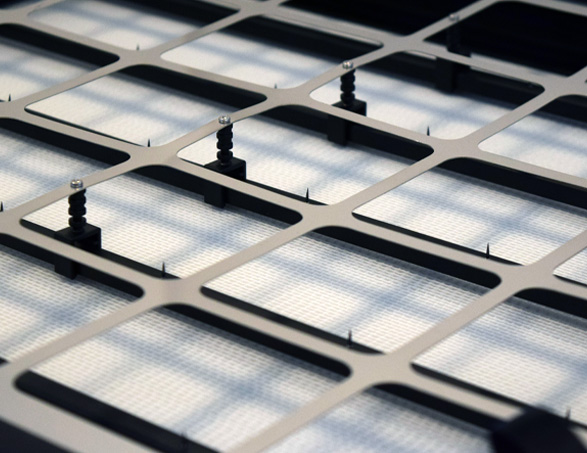
A rooftop unit does more than control the temperature: it supplies filtered outdoor air. In spaces with a high density of occupants, this factor has a greater influence on perceived comfort than temperature itself. The latest filtration sections achieve high efficiency classes under ISO 16890, capturing fine particulate matter, pollen and pollutants.
Clivet rooftop units can also adjust the outdoor air supply according to actual occupancy levels (based on CO2 measurements), avoiding unnecessary energy use by treating outdoor air only when it is needed.
Maintenance on the roof
All maintenance work takes place on the roof, without accessing areas open to the public. In a shopping centre or cinema, this means the system can be maintained during opening hours, without closures or having to set up work areas on the sales floor.